Thursday, September 20, 2007

Celebrity Attends DHS Reunion

Celebrity entertainer and Deadwood native Gary Mule Deer attended the DHS Reunion. He is shown with his mother Lola Miller DHS?? and relative Ruth Miller. Gary also attended Black Hills State College for most of the 60's as a Freshman. One wonders why he didn't play the legendary Johnny Cash in the recent hit movie.

See website http://garymuledeer.com/ for his interesting career and funny film clips. He was raised in the Black Hills and got his first start in the Deadwood Buffalo Bar but spent most of his earnings in a pin ball machine. At the end of his first night Ruby took him to her establishment to entertain the girls and their guests. Funny first start story and history, too bad we only saw a regular person at the Reunion.

Inferno update

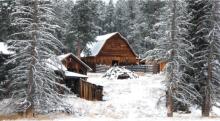
Dave Klein DHS54 just submitted this picture of the entrance to the Inferno he took on a recent trip to the Black Hills. He said it was difficult to find.


Looks like the passing years and surroundings have not been too kind.

Submitted by Bob Chyba


Bob Chyba DHS53 commented on book signing: Congratulations Yvonne.....your pics look good. I'd never recognize Dick. He grew up on the street in back of us and I was at his house almost daily in summer. His mom was our Cub Scout Leader. I started building a soap box derby racer and when school was out for the summer, I went to stay with my grandma and uncle by Yankton. Dick took what I had done and finished it. Won the derby in Lead with it and went on to the Nationals. In Akron OH I think. The town merchants bought the wheels and material for us kids and we built them in the basement of some bldg on Main St. The guy that was the overseer was Lyle Elwood. I remember he was the Postmaster and a nice guy. Funny I even remembered that.

~~~Dick D comment: Bob first meontioned Lyle Collins who is a nice guy too and is related to the Lee Street "Pop" Collins - Grab it and Growl. "Pop" hated Democrats so every Roosevelt dime he got went into the Slime Creek. Well at least some of them. A few years before "Pop" died he shared his recipe for Chili with me. It was in ingredient amounts to make a large "brick" of chili to store in refrigerator so that he never run out of chili. The first ingredient is lard which would really ring the trans-fat bell of today.~~~

Tuesday, September 18, 2007

Yvonne's Book Signing

Yvonne Spaulding Hendrickson's DHS53 book signing at the Deadwood SD Adams Museum on September 8, 2007. She added personal notes to the books and the proceeds went to the Museum.


Dick Dunwiddie DHS54 arrived to purchase his signed hard back copy and enjoy the museum setting.

Friday, August 31, 2007

And the rest of a neat story . . .


Evelyn Hendrickson Bear Log 1952


A few days ago Jim Hennen DHS56 contacted me to see if dhsclassmates could help him find Evelyn Hendrickson who was a Junior in DHS52. Jim had just opened a old box of personal items from his brother Gene Hennen DHS49 who passed away a few years ago. In the box were a number of old DHS Bear Logs and one from DHS52 that appeared to belong to Evelyn and was full of notes from fellow classmates. To help Jim, I contacted Yvonne Hendrickson DHS53 who only knew that Evelyn was not related but left DHS in 1952. We looked thru the current class roster and found Chuck Hendrickson DHS56. Chuck verified that Evelyn was his sister and gave Jim her address. Jim just contacted me with the rest of this neat story:

“I just hung up from talking to Evelyn Hendrickson Reller. Chuck Hendrickson returned my call and gave me her address. He visited for a long time considering I haven't seen or visited with him since 1956. Evelyn is his sister. I called her and she was ecstatic to find out I had her year book from 1952. I will be sending it to her after the long holiday weekend.

She has been a widow for a few years and lives in Minnesota. She said that she and her husband were in Montana and lost their belongings first in a fire and later in a flood and all that they had in the way of personal memories were hauled to the dump as a result.

I apologized for having read so many of the cherished notes that classmates had written in her book but I told her of notes from Carlyle and a few others and she asked, "Was there one from a "Sharon"? I said, yes, and by comparing signatures I assumed it was Sharon Moore. That nearly left her speechless for a second or so. It seems Sharon was her close friend at DHS (a sister of Marcia Moore). Sharon passed away sometime ago but was one who Evelyn had kept in contact with for all the years.

Small world. Is this a neat ending to the search for Evelyn Hendrickson Reller or what!

Thanks for your help,”
Jim Hennen

Comanche at the Custer Battle Field - Revised 9/18/2007

Picture from the Kansas State Historical Society

Revised to add:
Hello.

According to our exhibits director, a taxidermy mount is primarily of the hide on the animal stitched over a carefully formed manikin to resemble a life like pose. In this case (as with many mounts of the period) the Comanche mount also contains the skull, hip and shoulder bones and the long leg bones and hooves of the horse incorporated into the manikin form upon which the hide was stretched and sewn on.

The burial then must have been of the rest of the remains.

Hope that helps, -Jen

Jen Humphrey
Communications DirectorKU Biodiversity Institute
KU Natural History Museum

Wednesday, August 29, 2007

Comanche

A large framed orginial print of this picture hung in the Franklin Hotel lobby for years. This is "Comanche" the horse which was the only living thing found on Custer Hill after the June 25th 1876 Battle of the Little Big Horn or whatever it is called today.

From Wikipedia 8/31/07:

Comanche was a mixed
Mustang Morgan horse who survived General George Armstrong Custer's detachment of the US 7th Cavalry at the Battle of the Little Bighorn.
He was bought by the
U.S. Army in 1868 in St. Louis, Missouri and sent to Fort Leavenworth, Kansas. Captain Myles Keogh of the 7th Cavalry liked the 15 hand bay gelding and bought him for his own personal mount, to be ridden only in battle. In 1868, while fighting the Comanche in Kansas, the horse was wounded in the hindquarters by an arrow, but continued to let Keogh fight from his back. Thus the horse was named “Comanche” to honor his bravery. Comanche was wounded many more times, always exhibiting the same toughness.

On June 25, 1876, Captain Keogh rode Comanche at the
Battle of the Little Bighorn, led by Lt Col. George Armstrong Custer. The battle became famous when their entire detachment was killed. Comanche was found two days after the battle, badly wounded. After being transported by steamboat to Fort Lincoln, he was slowly nursed back to health.

After a lengthy convalescence, Comanche was retired and orders were given that he should never be ridden again. As an honor, he was made “Second Commanding Officer” of the 7th Cavalry. At
Fort Riley, he became something of a pet, occasionally leading parades and indulging in a fondness for beer.

Comanche died in
1890. He is one of only two horses in United States history to be buried with Full Military Honors, the other being Black Jack http://www.aaa.com/aaa/006/EnCompass/2004/jun/jun_GuardingHistory.html

His remains were sent to the University of Kansas and preserved, where they can still be seen.
Comanche is often described as the sole survivor of Custer's detachment, but like so many other legends surrounding the Little Bighorn battle, this one is false. As historian
Evan S. Connell writes in Son of the Morning Star: "Comanche was reputed to be the only survivor of the Little Bighorn, but quite a few Seventh Cavalry mounts survived, probably more than one hundred, and there was even a yellow bulldog.

Comanche lived on another fifteen years, and when he died, he was stuffed and to this day remains in a glass case at the University of Kansas. So, protected from moths and souvenir hunters by his humidity-controlled glass case, Comanche stands patiently, enduring generation after generation of undergraduate jokes. The other horses are gone, and the mysterious yellow bulldog is gone, which means that in a sense the legend is true. Comanche alone survived."

Email from University of Kansas 8/31/07:


Hello and thank you for your inquiry. Yes, we have the preserved (taxidermied) remains of Comanche housed in an exhibit on the fourth floor of our museum in Lawrence, Kan. He was preserved by naturalist Lewis Lindsay Dyche. You can read about our efforts to move Comanche from one exhibit into a modern one and see several photographs at
http://www.nhm.ku.edu/Hdocs/Comanche.html

Jen Humphrey
Communications Director
KU Biodiversity Institute
KU Natural History Museum